
Beyond Autocomplete: AI’s Next Three Evolutionary Leaps
LLMs autocomplete text. What if AI learned to simulate worlds, discover causes, and prove theorems instead? Three paradigm shifts worth watching.

LLMs autocomplete text. What if AI learned to simulate worlds, discover causes, and prove theorems instead? Three paradigm shifts worth watching.

AI didn’t break your processes—it exposed them. Most companies automate chaos instead of redesigning workflows. The fix: outcomes over tasks, streamline first, treat data as fuel.

You don’t need traditional dev skills if you master directing AI tools like a tech lead—not just prompting, but architecting, chunking problems, and verifying output at scale.

AI can predict how you feel better than most humans, but doesn’t actually feel anything. Studies show it outperforms crisis workers at validation—and you can tune it.

Multi-agent AI systems fail without emotional intelligence guiding them. Here’s how self-awareness, empathy, and social skills prevent chaos and turn your agents into a functional team.

Forget fuzzy “human in the loop” advice. Use three knobs—risk, ambiguity, visibility—to decide where you stay in control vs. let agents run free.

AI lies confidently—inventing citations, features, even violent phrases in calm audio. The future isn’t perfect models, it’s skilled users who cross-check, fact-verify, and keep humans in the loop.

You’re already debugging prompts without realizing it. Here’s when to iterate vs. nuke the chat—and the deeper skill underneath both moves.

Stop throwing “do everything” prompts at AI. Break work into tiny, clear blocks with one role per task. Define context, constraints, and acceptance criteria first—AI executes, you architect.

Software that researches your audience, writes posts in your voice, and publishes on schedule—so you stop guilt-posting in bursts and vanishing for weeks.

Most businesses don’t lack content ideas—they lack time. Creative Robot researches, writes, optimizes, and schedules posts in your voice so you stay visible without the grind.

Your AI confidently bullshits half the time. Here’s how to design questions and checks that separate “sounds smart” from “is actually right.”

AI gets way smarter when you stop asking it to solve your big problem and instead break that problem into a sequence of tiny, well-defined jobs it can actually nail.

CEOs and leaders often have no safe space to process feelings. So I built EmpathyBot—a free AI coach that listens without judgment and helps you hear your own wisdom.

Leaders face big decisions with zero safe space to admit fear. EmpathyBot.net offers free, private AI coaching to practice empathy, rehearse hard talks, and clarify next steps—no ads, no performance required.
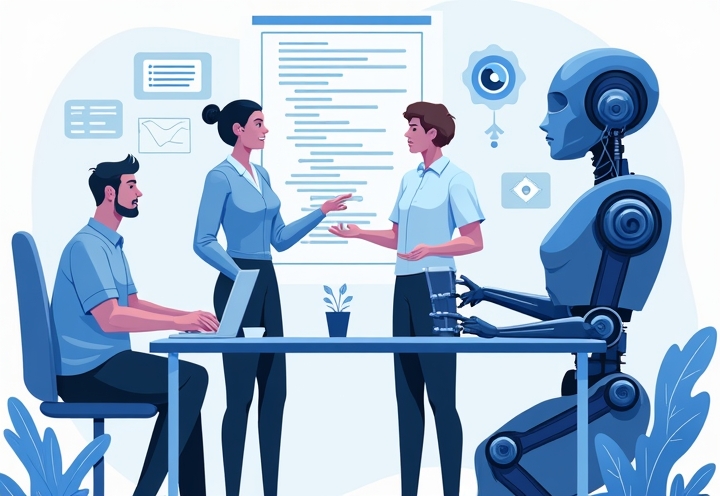
Treat AI agents like junior devs on your team—not magic buttons or threats. Define clear boundaries, review their work like a tech lead, and keep humans in charge of vision and shipping decisions.

AI made syntax optional but design thinking mandatory. Non-developers can now ship working software—just not necessarily good software. The new skill isn’t coding faster, it’s thinking clearer.

AI didn’t replace software experience—it exposed what mattered all along. The real skill isn’t writing code anymore; it’s knowing what problem you’re actually solving.

AI can detect emotions and outperform humans on EQ tests, but it’s pattern recognition, not actual feeling. The key: get precise about what emotional support you want.

The uncomfortable truth about AI delegation – it’s slower at first, and treating it like a slightly overconfident junior dev is the only way it actually works.

Think AI will replace devs? Nah. The real question is how to build teams where humans and AI make each other better at the hard stuff that actually matters.

Months of testing proves the “best” LLM doesn’t exist. Real skill is matching the right model to the task – and most people waste time arguing instead of learning.

Testing different LLMs for coding taught me this: the model matters less than knowing how to break down problems and write specific prompts. Claude explains, GPT-5 generates, Copilot flows.

I trusted AI code too easily until production failures taught me otherwise. Here’s how to catch the confident mistakes before they bite you.

AI agent teams work better when you treat them like emotionally intelligent humans – understanding each agent’s strengths, managing their cognitive load, and letting them collaborate naturally.

Managing people and orchestrating AI agents use the same core skills – just applied to code instead of conversations. Recognition becomes observation, pattern analysis becomes prediction, and conflict resolution becomes debugging.

You’re using AI coding assistants wrong – they don’t need more freedom, they need better rails. 30 years of coding plus 8 years of AI work taught me why constraints beat creativity.

AI coding isn’t about autonomy – it’s about constraints. After 30+ years coding, I’ve learned the real breakthrough is “agents on rails” with precise specs.

After 30+ years coding, I’ve watched teams waste hours on AI that generates creative but wrong solutions. The AI isn’t broken – your instructions are missing.

We’re training autocomplete engines and calling it intelligence. The next breakthrough probably won’t come from bigger LLMs – it’ll abandon pattern matching entirely.
Recent Comments